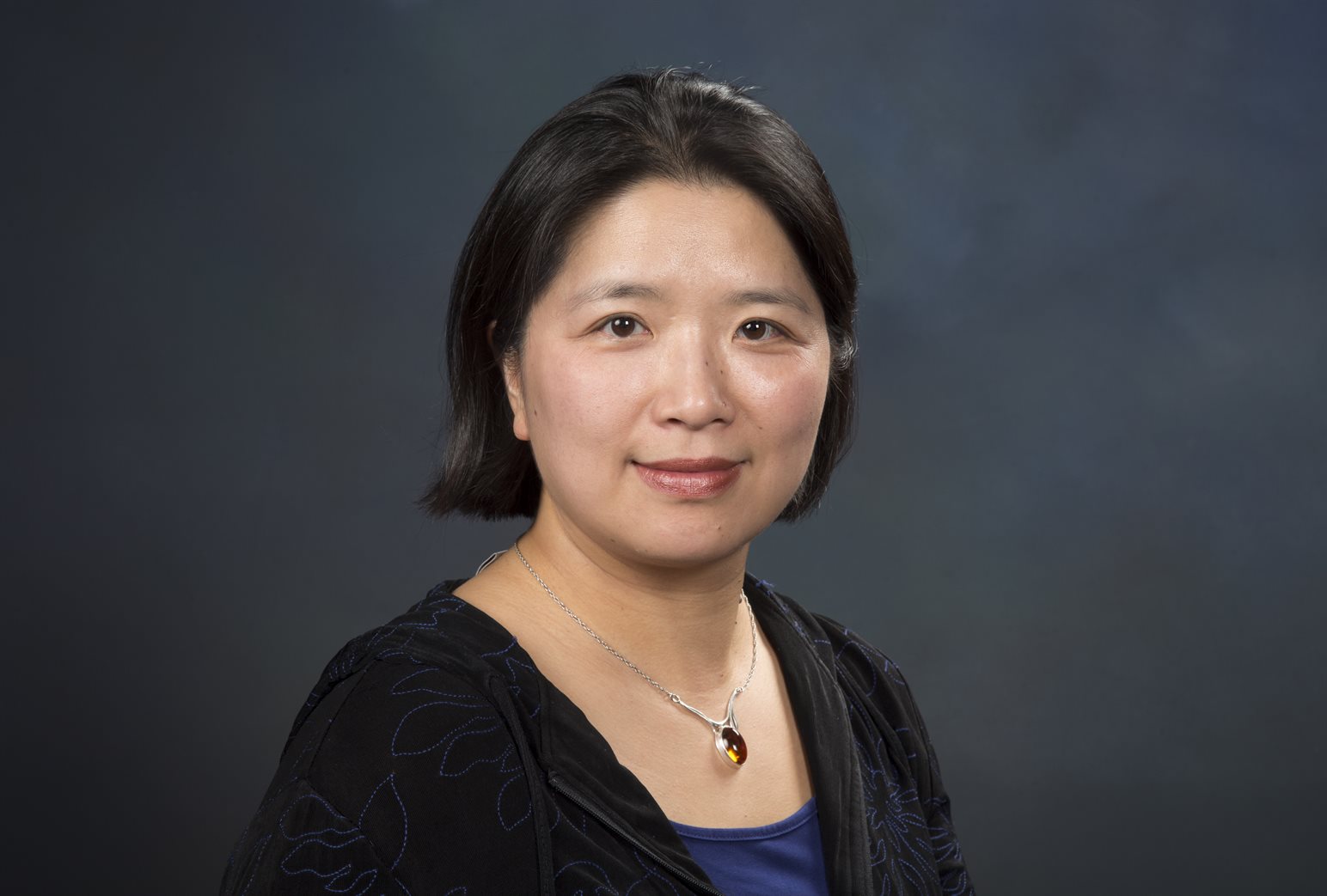
 The National Academy of Sciences (NAS) has elected to membership Illinois Physics Professor Chen-Yu Liu for her pioneering contributions to nuclear physics. NAS membership is a widely accepted mark of excellence in science and is considered one of the highest honors that a scientist can receive. A total of 120 new members and 24 international associates were elected this year in recognition of their distinguished and continuing achievements in original research. Liu is among three newly elected members from the Urbana-Champaign campus.
Liu is recognized internationally for her seminal work on neutron experiments. Made up of quarks and subject to the so-called strong force, the neutron is about the same mass as a proton but has no electric charge. The fundamental properties of the neutron have been extensively studied, but certain measurements continue to present tremendous experimental challenges. Liu develops novel experimental techniques to elucidate the neutron beta-decay lifetime, neutron decay asymmetries, and the electric dipole moment of the neutron. Much of Liu’s work involves ultra-cold neutrons, which have low kinetic energies and so can be stored in material bottles or magnetic traps for up to a few minutes at a time—long enough to enable higher precision measurements.
Liu takes a leadership role in three collaborative experimental efforts at national research facilities. The Ultra Cold Neutron Half-Life experiment (UCNτ) at Los Alamos National Lab (LANL) and the Beam Neutron Lifetime 3 experiment (BL3) at NIST measure the neutron lifetime through disparate experimental approaches. The Neutron Electric Dipole Moment experiment (nEDM) at LANL measures the electric dipole moment (EDM) of the neutron using nuclear magnetic resonance (NMR). She has also recently joined an effort (Project-8) to measure the absolute mass of neutrinos through beta-decays of tritium atoms.
These experiments seek to answer some of the most pressing open questions about the neutron, a subatomic particle present in all atomic nuclei except those of ordinary hydrogen. Liu’s neutron research sheds light on the creation of matter and nucleosynthesis in the early universe. It also has implications for our understanding of physics beyond the standard model of particle physics.
Liu is a Fellow of the American Physical Society. Liu’s teaching and research have been recognized with numerous accolades. Among these, she was named a Rosen Scholar at the Los Alamos Neutron Science Center (2016), received the NIST Precision Measurement Grant twice (2015 and 2022), and was named a Sloan Research Fellow by the Alfred P. Sloan Foundation (2007).
Liu received her bachelor’s degree in physics from the National Taiwan University, Taipei, Taiwan in 1997 and a doctoral degree in physics from Princeton University in 2002. She held a postdoctoral appointment at Los Alamos National Laboratory from 2002 to 2005, before joining the faculty at Indiana University in 2005. She was the James H. Rudy Professor of Physics at Indiana from 2019 to 2022. Liu joined the faculty at Illinois Physics in August 2022 as a full professor.
About the National Academy of Sciences
Established by President Lincoln in 1863, the National Academy of Sciences is charged with providing independent, objective advice to the nation on matters related to science and technology. Scientists are elected by their peers to membership in the NAS for outstanding contributions to research. The NAS is committed to furthering science in the United States, and its members are active contributors to the international scientific community.